Wild Dancing Thanksgivng Turkey

Wednesday, 6 April 2016

Reflection Week 9

Week 9

Curriculum Implementation in Developing Curriculum
     On 9 week our group completed the assignment 2 and sent on Friday. After completing the assignment for this subject. Condition improved and increased appetite. hihi

 This week we continue learning about curriculum implementation. in this topic has five aspects, they are:
  • Curriculum Components
  • Curriculum Contents
  • How to select Content?
  • How Content are Organized?
  • What Criteria for Selecting Content ?
1. Curriculum Components

Aspect needed in curriculum components:

  • What subject matter is crucial to learn?
  • What is essential to know to be successful citizen?
  • What contents best addressed students' interests and needs?

2. Curriculum Contents
  • Knowledge results from a structuring and reconstructing of perceived realities.
3. How to Select Content?
  • It addresses the cognitive, social, and psychological dimensions of the individual student.
  • Content it is fact, concepts, generalization, and theories which are similar to disciplined knowledge, eg. Chemistry
4. How Content are Organized?

  • Based on theories
  • Organized into domains
  • Contents should be systematic, practicality and sequenced.

5. What Criteria for Selecting Content ?

  • self-sufficiently
  • significance
  • validity
  • interest
  • utility
  • learnability

Wednesday, 30 March 2016

Reflection Week 8

Week 8

Continued: Curriculum Theory and Practice

The following are the four ways of approaching curriculum theory and practice:

Curriculum as a body of knowledge to be transmitted.

  • Curriculum cannot be equated with a syllabus which in essence means a concise statement or table of the heads of a discourse, the contents of a treatise, and the subjects of a series of lectures. It is connected with courses leading to examination. This view of the curriculum limits planning to a consideration of the content or the body of knowledge that may be transmitted. 

Curriculum as an attempt to achieve certain ends in students - product.

  • However varied human life may appear to be, it consists in the performance of specific activities. Therefore, education should prepare a student for life, i.e., preparing definitely and adequately for such activities. Though they may be numerous and diverse they can be discovered for any social class. This requires one to go out into the world of affairs and discover the particulars of which his/her affairs consist. And as such the abilities, attitudes, habits, appreciations and forms of knowledge that men need will be shown. These have to be the objectives of the curriculum, thus making it (curriculum) a series of experiences which children and youth must have by way of obtaining those objectives. 
Curriculum as process.

  • Looking at the as a process curriculum is not a physical thing, but rather the interaction of teachers, students and knowledge. In other words, curriculum is what actually happens in the classroom and what people do to prepare and evaluate. 
Curriculum as praxis. 

  • Whereas the process model is driven by general principles and places an emphasis on judgment and meaning making, it does not make explicit statements about the interests it serves. The praxis model of curriculum theory and practice on the other hand brings these to the centre of the process and makes an explicit commitment to emancipation. Thus action is not simply informed, it is also committed. That is, the curriculum is not simply a set of plans to be implemented, but rather is constituted through an active process in which planning, acting and evaluating are all reciprocally related and integrated into the process 
  • Therefore, curriculum should in due course produce students who would be able to deal efficiently with the contemporary world. It should not be presented as finished concept, but should include the child’s preconceptions and should incorporate how the child views his/her own world. This perspective uses four instincts, to describe how to characterize children’s behavior. They consist of social, constructive, expressive, and artistic. Curriculum should then build an orderly sense of the world where the child lives. As a curriculum designer I have to use livelihoods to connect diminutive account of fundamental activities of life classroom activities. This could be accomplished by combining subject areas and resources. It means I have to make connections between subject matter and the child’s life.

Wednesday, 23 March 2016

Reflection Week 7

Week 7


Curriculum Theory and Practice


1. What is Curriculum Theory

        Curriculum theory (CT) is an academic discipline devoted to examining and shaping educational curricula. There are many interpretations of CT, being as narrow as the dynamics of the learning process of one child in a classroom to the lifelong learning path an individual takes. CT can be approached from the educational, philosophical, psychological and sociological disciplines. James MacDonald states “one central concern of theorists is identifying the fundamental unit of curriculum with which to build conceptual systems. Whether this be rational decisions, action processes, language patterns, or any other potential unit has not been agreed upon by the theorists.” Curriculum theory is fundamentally concerned with values, the historical analysis of curriculum, ways of viewing current educational curriculum and policy decisions, and theorizing about the curricula of the future. Pinar defines the contemporary field of curriculum theory as “the effort to understand curriculum as symbolic representation”.
      The first mention of the word “curriculum” in university records was in 1582, at the University of Leiden, Holland: “having completed the curriculum of his studies”. However, curriculum theory as a field of study is thought to have been initiated with the publication of The Yale Report on the Defense of the Classics in 1828, which promoted the study of a classical curriculum, including Latin and Greek, by rote memorization.


2. Four Approaching Curriculum Theory

Wednesday, 16 March 2016

Reflection Week 6

Week 6


Curriculum Design

Before I discuss this topic, I sense that this topic is very relevant to a given task group assignment. I understand after reading this topic.
        In week six we have  learn about the curriculum design. Based on my knowledge, curriculum design is how we shape events or regulations at a school or what should be done based on the National Curriculum.
       In my reflection on this time, I will explain the meaning of curriculum and curriculum content elaborate a little bit.

1. What is Curriculum Design?

     Curriculum design is an aspect of the education profession which focuses on developing curricula for students. Some education professionals specialize in curriculum design, and may spend all of their time working on curricula, rather than teaching in the classroom, while in other cases working teachers develop their own curricula. Curriculum design is also practiced by parents who home school their children, sometimes with the guidance of an experienced education professional who can provide advice and suggestions, and sometimes with the assistance of experienced preschoolers.
     In many nations, specific benchmark standards are set for education to ensure that children across the nation achieve a similar level of education. For example, a government may dictate when children should start to learn multiplication and division, set standards for reading ability, and so forth. One aspect of curriculum design involves reviewing these standards and determining how they can be met or exceeded.
      Another aspect involves thinking about the students themselves, and what type of curriculum would be most appropriate. Students come from a wide variety of cultural and class backgrounds, and curriculum design should not be a one size fits all approach. Methods which work in a school located in an upper class district may not be appropriate for a school in an area with many immigrants who do not speak the primary language of instruction, for example, and methods used with students who are language learners would not work for children with intellectual disabilities. A skilled curriculum designer needs to think about the needs of the student population he or she is serving.
    Curriculum design may also include a consideration of limitations. A homeschooling parent, for example, might be able to make time to take a student on a trip to London to see historical items in museums to learn in context, while an entire classroom in Bangkok could not reasonably replicate this experience. Limitations can include issues like funding, access to textbooks, moral norms in the region where the students are being taught, and limitations set by the school district. For example, someone who works on curriculum design for sexual education programs may be designing curricula for school districts in which certain subjects cannot be discussed, requiring an adjustment to the curriculum.
     Flexibility is another important aspect of curriculum design. Many classroom teachers are working with students of different levels of ability, and they need to be able to adjust the curriculum to keep all of the students engaged and learning. It may also be necessary to change the pace of a curriculum to deal with problems as they arise; for example, a class might have more trouble grasping a concept than was expected, and the teacher needs to be able to spend more time on it, rather than racing on to the next subject and leaving students confused.

2. Elements of Curriculum

  • Aims, Goals and Objectives
  • Subject Mater/Content
  • Learning Experiences
  • Evaluation Experiences


Wednesday, 9 March 2016

Reflection Week 5

Week 5


Topic 4: Psychological Foundations of Curriculum

     Hi good evening, forgive me for being late do reflection for this weeks 5. I Late do my reflect on this week because the weather was very hot and makes my body always tired. Other than that, the haze around us. But before I go to class on this week I have been dining at one of the restaurant near the college. My menu on the day is Cheese Nan. (This sounds like delicious, right)

These kinds of real Cheese Nan I had eaten. forgive me for displaying  this meal at night HEHE
    
      Back to the task, based on this topic 4, I understand the basic definition of psychology curriculum with respect to the question of how people learn. It provides a basis for understanding the process of teaching and learning. This topic discusses the three main theories in the learning process and the figures that explain the theory.

What is Psychological?
  • Concerned with the question of how people learn, and curriculum specialists ask how psychology can contribute to the design and delivery of curriculum. It provides a basis for understanding the teaching and learning process. Both processes are essential to curriculum workers because the curriculum has worth only when students learn and gain knowledge. the unifying element of the learning process; it forms the abs is for the methods, materials,and activities of learning, and provides many curriculum decisions.
Importance of this Foundations
  • Teaching the curriculum and learning it are interrelated, and psychology cements the relationship.
  • This disciplined field of inquiry furnishes theories and principles of learning that influence teacher-student behavior within the context of the curriculum.
  • Basis for understanding how the individual learner interacts with objects and persons.
  • Screen for helping determine what our objectives and how learning takes place.

1. Behavioral Psychology
  • Edward Thorndike

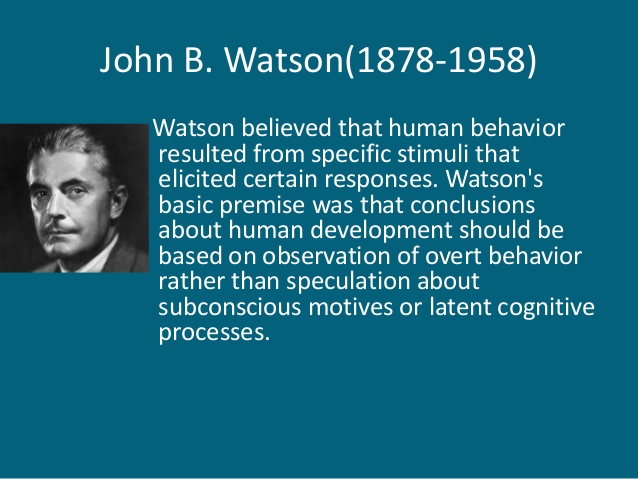
    • James B. Watson


  • Skinner


2. Cognitive Psychology

  • Jean Piaget's Stage of Cognitive Development


  • Howard Gardner - Theory of Multiple Intelligence
  • Vygotsky - Zone of Proximal Development


3. Phenomenological and Humanistic Psychology
  • Maslow


Wednesday, 2 March 2016

Reflection Week 4

Week 4


Topic 3: Philosophical Foundations of Curriculum.

   Hello dear friends. Today we are by week 4 and the week assignment. On this week we have been surprised by the arrival the assignment of other subjects. Coming of assignment will add more another subject of my job this week and next week. Therefore, what I have to do is set up this assignment.

    Other than that, on this week we have been given a description of the assignment subject curriculum and pedagogy. At first a bit tricky but after explanations made by our lecture of Miss.Soliam, we have an idea and start doing our assignments. While the title / topic that we learned in week 4 is Topic 3: Philosophical Foundations of Curriculum.

    In Topic 3 I have studied four aspects, they are the psychological foundation of curriculum, meaning of philosophy, the major philosophies and educational philosophies.


1. The Psychological Foundation of Curriculum

  • What is Philosophy?
     Quite literally, the term "philosophy" means, "love of wisdom." In a broad sense, philosophy is an activity people undertake when they seek to understand fundamental truths about themselves, the world in which they live, and their relationships to the world and to each other. As an academic discipline philosophy is much the same.

     Those who study philosophy are perpetually engaged in asking, answering, and arguing for their answers to life’s most basic questions. To make such a pursuit more systematic academic philosophy is traditionally divided into major areas of study.
  •  What is Philosophy in Education?
     Philosophy of education can refer to either the academic field of applied philosophy or to one of any educational philosophies that promote a specific type or vision of education, and/or which examine the definition, goals and meaning of education.


2. The Major Philosophies

  • Idealism: Aim search for truth & values.
  • Realism: People can come to know the world through their sense & reason.
  • Existentialism: Individually & personal self-fulfillment.
  • Pragmatism: Referred to as experimentalism, based on change, process, and relativity.


3. Educational Philosophies

  • Essentialism
  • Progressivism
  • Perennialism
  • Existentialism
  • Behaviorism

Wednesday, 24 February 2016

Reflection Week 3

Week 3


Topic 2: The Roles of Curriculum Worker

Through this topic, it will be discussed about curriculum workers, curriculum practitioners, classroom teacher, curriculum evaluates, curriculum advocates, curriculum developer and curriculum theorists. 

1. Curriculum Workers

People who work on curriculum engage in many different types of endeavors. Curriculum workers had the first time approach that appeared both comprehensive and workable. They are advised to concentrate on student behaviors in devising objectives for a unit to emphasize appropriate learning experiences rather than simply identifying content to be covered.


  • Curriculum practitioners use curricula within the instructional arena and super- vise its use in schools.
  • Classroom teachers who plan instruction using social studies textbooks, implement a reading program, or derive a science program from curriculum ideas offered on a Web site are curriculum practitioners. 
  • School administrators who make curriculum adjustments to meet state or national curriculum standards, implement team teaching, encourage teachers to utilize a particular instructional methodology, or insist on the use of a particular textbook series are also curriculum practitioners. 
  • Curriculum disseminators make known to curriculum practitioners the existence of curricula and the proper methods of using them. A curriculum disseminator might be a textbook salesperson, a school district subject matter specialist, a college professor offering a methods course, or a workshop leader for a publishing company or professional organization.

2. Curriculum Advocates


  • Curriculum advocates are educators and members of the general public who are concerned about and attempt to influence what is taught in schools and how it is taught. 
  • A curriculum advocate might be a parent attempting to influence the curriculum decisions of his child’s school, a citizen trying to influence the curriculum decisions of the state department of education, or a politician (perhaps a president, governor, or legislator) attempting to implement her curriculum ideas through the political process.


3. Curriculum Developer

  • Curriculum developers intentionally create curriculum materials and strategies for others to use in the instructional arena. The important ideas here are “for others to use” and “instructional.
  • Curriculum developers can be textbook writers, teachers who work on school curriculum committees, curriculum specialists who work for private educational organizations, or concerned citizens who design instructional materials for homeschooling.

4. Curriculum Theorists

  • Curriculum theorists examine the philosophical and ideological underpinnings of existing curricula;
  • study how curricula are used, disseminated, created, and evaluated; study the endeavors and intents of other curriculum workers;
  • speculate on what curricula should accomplish; probe the “whys” of their own examinations; and
  • write books such as this one, all for the purpose of contributing to the general body of knowledge about effective curriculum practice, dissemination, advocacy, development, and evaluation.